
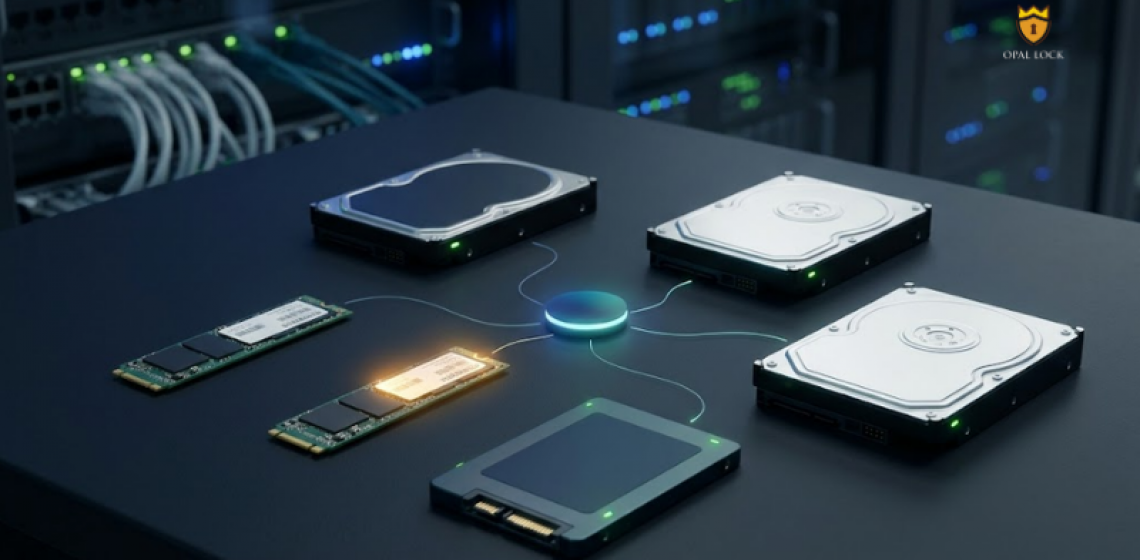
Why the most resilient companies treat data protection as a boardroom priority, not a backend task.
Every leadership team talks about growth, innovation, and digital transformation. Far fewer talk about the thing that actually makes those ambitions sustainable: protecting the data that powers them.
Data encryption used to live quietly inside the IT department. That’s no longer the case. As breaches, ransomware, and regulatory scrutiny escalate, encryption has moved into the boardroom, and the leaders who treat it as a strategic priority are the ones building companies that can withstand a bad day.
Think of it this way: a digital strategy without encryption is a skyscraper without a foundation. It can look impressive right up until something shakes it, a breach, a lost device, a compliance failure. By then, it’s too late to retrofit.
This is where tools like Opal Lock by Fidelity Height come in, giving leaders a practical way to build encryption directly into their technology stack instead of bolting it on after the fact.
Cybersecurity used to be something IT handled quietly in the background. Today, executives are personally accountable for how their organizations protect data, not just how they grow revenue.
Encryption is the simplest way to meet that accountability. It ensures that even if data is stolen, it’s unreadable and useless to whoever took it. CEOs and CIOs who still treat drive encryption as optional are leaving a gap that auditors, regulators, and attackers will all eventually find.
Data is now one of a company’s most valuable, and most exposed, assets. A single leak of customer records or internal contracts can trigger lawsuits, reputational damage, and a loss of shareholder confidence that takes years to rebuild.
That’s why forward-looking leaders track data privacy as a measurable part of their strategy, not an afterthought. Encryption is the mechanism that makes that protection real: it turns sensitive information into something unreadable without authorization, full stop.
In competitive markets, trust is currency. Customers, partners, and investors all want assurance that their data is safe, and strong encryption is one of the clearest ways to demonstrate that.
In regulated industries like finance, healthcare, and education, companies using hardware-based encryption, self-encrypting drives (SEDs) for example, signal something important: they don’t just talk about security, they’ve built it into the product.
Every organization faces the same quiet risks: a stolen laptop, an employee mistake, a ransomware attempt. Without encryption, a single lost drive can expose sensitive data within hours.
With hardware encryption in place, that same lost or stolen drive becomes a non-event. The data stays unreadable, even if the drive itself is removed or cloned. Platforms like Opal Lock let organizations deploy this protection across hundreds or thousands of devices at once, making encryption a core part of business continuity planning, not just a technical detail.
Data doesn’t sit still. It moves across devices, inboxes, and cloud platforms constantly. Data loss prevention (DLP) tools give leaders visibility into that movement: who’s accessing files, copying them, or sending them outside approved environments.
Combined with hardware encryption, DLP creates a more complete picture of data protection, fewer blind spots, stronger compliance, and more confidence at the leadership level.
Real corporate data privacy isn’t a policy document. It’s a design choice. When hardware encryption, file encryption, and access controls are built into the technology stack itself, privacy becomes automatic rather than something employees have to remember to do.
Whether it’s payroll records, board notes, or unreleased product plans, encryption by design means sensitive files stay protected no matter where they travel.
Technology will keep changing. The need to protect what matters most won’t. A resilient executive data strategy typically includes:
None of these eliminate risk on their own, but together, they build the kind of confidence regulators, clients, and stakeholders are increasingly demanding.
A common hesitation: “Won’t encryption slow things down?” With modern self-encrypting drives, the answer is no. Encryption runs at the hardware level, quietly, without taxing performance or disrupting workflows. With platforms like Opal Lock, it can be deployed across an entire fleet without employees noticing a thing, except that they’re now protected.
When executives visibly prioritize encryption, it sends a message through the whole organization: data protection isn’t an IT formality, it’s part of the culture. That tone setting matters. Strong leadership around data security builds trust with employees, investors, and clients alike.
Regulations like GDPR, CCPA, and ISO 27001 require companies to protect personal and corporate data. Leaders who treat this purely as a box to check miss the bigger opportunity: compliance, done well, is proof of operational discipline.
Tools like Opal Lock help automate encryption policies that map directly to these frameworks, reducing manual risk while strengthening the story you can tell regulators, auditors, and customers.
Encryption is often viewed as a cost center. In reality, it’s closer to insurance with a built-in return: a single breach involving unencrypted data can cost millions in fines, downtime, and recovery, costs that a properly encrypted drive simply removes from the equation. For most leadership teams, that math isn’t close.
Remote work has multiplied the number of places sensitive data can leak from: laptops, USB drives, cloud transfers, home networks. Hardware encryption closes these access points automatically, protecting data even when it’s far outside the corporate perimeter. That’s what lets leaders offer real flexibility without quietly increasing risk.
Old laptops and drives don’t disappear. They get reassigned, resold, or recycled, often without anyone thinking twice about what’s still on them. Self-encrypting drives solve this with secure erase: once the encryption key is deleted, the data on the drive becomes permanently unreadable. With Opal Lock, this can be done remotely and documented, giving leadership a clean, compliant way to retire hardware.
Leadership in the digital age isn’t measured by how much data a company collects. It’s measured by how well that data is protected.
Encryption isn’t a line item anymore. It’s a leadership decision that touches trust, compliance, continuity, and reputation all at once.
Opal Lock by Fidelity Height gives leaders a practical way to put that decision into action, combining hardware-level encryption, visibility, and control in one platform built for real-world deployment.
Why should business leaders focus on encryption? Because data protection is now a leadership responsibility, not just a technical one. Encryption keeps sensitive information secure and unreadable, even during a breach.
How does encryption support an executive data strategy? It directly supports core business goals: reducing risk, simplifying compliance, and strengthening customer trust through secure systems and devices.
Does encryption slow down performance? No. Modern self-encrypting drives handle encryption at the hardware level, with no noticeable impact on speed or workflow.
How does encryption protect remote teams? Self-encrypting drives keep data secure on every laptop and storage device, even outside the corporate network, no extra effort required from employees.
Want to see how Opal Lock fits into your organization’s data strategy? Explore Opal Lock or reach out to our team
Ready to buy
Activate hardware encryption on compatible Opal drives in minutes. Select your edition and complete purchase below.
