
Walk into any bank today and you’ll see vaults, cameras, and guards everywhere.
But the real treasure isn’t in the cash rooms anymore it’s inside hard drives and data centers.
Customer details, loan histories, digital transactions, and credit reports all stored in computers and servers that run around the clock.
This is why banking data security has become the backbone of modern finance.
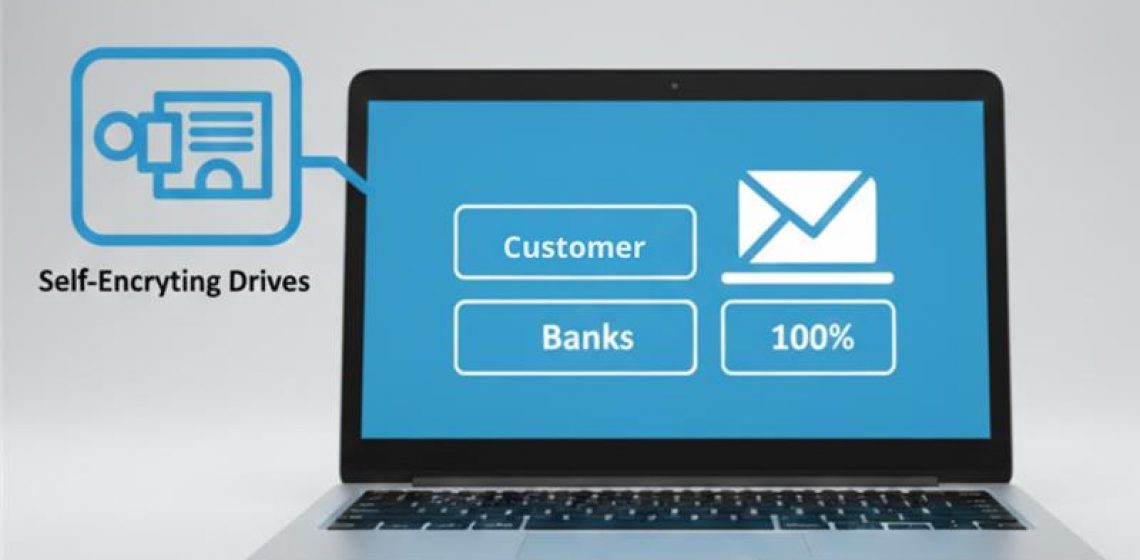
And at the center of this transformation lies one simple but powerful technology: Self-Encrypting Drives (SEDs).
Banks have always been security-focused. But in the digital age, cyberattacks, insider leaks, and stolen devices have replaced vault break-ins.
According to financial reports, over 70% of global financial data breaches start from lost or misused endpoints such as laptops or portable drives.
The problem isn’t always hackers it’s often unencrypted data.
That’s where SED encryption changes the game. It ensures that even if physical drives fall into the wrong hands, the data remains locked and unreadable.
A Self-Encrypting Drive (SED) is a storage device that automatically encrypts all data written to it and decrypts it only for authorized access.
Unlike traditional drives, it doesn’t depend on your operating system or external software.
The encryption happens inside the drive itself using a built-in hardware chip, ensuring banking data security even if the system is offline.
Each drive holds its own unique encryption key, which never leaves the device.
This means even if hackers clone the drive, they get nothing but unreadable data.
Most banks once relied on software encryption tools for protecting data.
But as data volumes and compliance demands grew, limitations became obvious.
Software encryption:
SED encryption:
This makes SEDs not just faster but also more secure and compliant with global financial compliance security standards.
Solutions like Opal Lock by Fidelity Height take it further by offering centralized control, remote management, and instant drive locking for financial institutions.
In banking, milliseconds matter. Every transaction, every customer login, and every database query must happen securely and instantly.
Hardware encryption provides that balance of speed and safety.
Unlike software solutions, it doesn’t slow down high-volume systems such as online banking portals or credit risk engines.
Hardware encryption at the drive level ensures:
It’s why banks, credit unions, and financial institutions have made hardware encryption a non-negotiable requirement.
In finance, trust is everything.
When customers deposit money, they trust that their bank not only protects their savings but also their information.
Self-Encrypting Drives (SEDs) protect this trust by keeping sensitive data secure even during system failures, upgrades, or maintenance.
Even IT engineers or third-party vendors can’t access the data without proper authorization.
This invisible protection gives banks and customers confidence that their digital assets are always safe.
Global banking regulations such as GDPR, PCI DSS, and GLBA demand strict data protection measures.
For compliance officers, encryption isn’t a luxury it’s a legal requirement.
SED encryption satisfies multiple compliance standards by:
Opal Lock by Fidelity Height simplifies this process with centralized control panels that align encryption management with financial compliance security policies.
This means compliance reports can be generated effortlessly without manual verification.
Modern banking doesn’t stay inside office buildings anymore.
From mobile loan officers to auditors working remotely, financial data now travels everywhere.
That’s why hardware-based encryption and data loss prevention software must extend beyond the office network.
Opal Lock helps financial institutions secure remote laptops and portable storage drives used by field employees, ensuring that all devices follow the same encryption standards no matter where they go.
This is a vital part of today’s banking data security strategy.
Financial databases store millions of customer records, credit histories, and transactions.
If compromised, they can lead to massive losses and regulatory penalties.
Database protection and SED encryption together create a double defense.
While database activity monitoring tracks suspicious behavior, SEDs ensure that even physical database storage remains encrypted and tamper-proof.
This combination ensures that data is protected at rest, in motion, and in use the three pillars of secure financial data handling.
Banks regularly replace storage drives as part of their maintenance cycles.
But simply deleting files or formatting drives isn’t enough.
Unencrypted drives can still reveal information through forensic recovery tools.
SEDs solve this instantly using Secure Erase, which deletes the encryption key inside the drive, rendering all stored data permanently inaccessible.
This capability is crucial for financial compliance security, especially during audits or asset disposal.
Opal Lock by Fidelity Height automates this process so that drives leaving a bank’s ecosystem are guaranteed clean and compliant.
Financial networks process thousands of transactions per second.
Adding software encryption to every process would slow down operations significantly.
SED encryption, however, happens instantly without burdening the CPU.
It delivers:
Banks can secure ATMs, loan processing systems, and core banking servers all without changing existing software structures.
That’s why SEDs have become a trusted hardware standard across the global financial industry.
Not every threat comes from outside.
In many financial institutions, insiders or contractors may have technical access to systems.
With SED encryption, even authorized staff cannot view or copy sensitive data unless they have the encryption credentials.
This minimizes insider misuse and ensures all actions remain within compliance guidelines.
It’s a silent but effective layer of defense that’s redefining banking data security.
Opal Lock by Fidelity Height enables financial organizations to manage encryption policies for all their devices from one place.
Features include:
With these tools, IT departments can enforce encryption across all branches, ensuring consistent protection and compliance with industry standards.
From mobile advisors to ATMs, many financial endpoints are physically exposed to public environments.
If a laptop or ATM drive is removed, unencrypted data could be extracted in minutes.
But with hardware encryption and Opal Lock, these drives remain inaccessible without the encryption key.
Even physical theft becomes pointless.
This practical security approach has made SEDs the first choice for financial compliance security globally.
As banking becomes more digital and mobile-driven, customer privacy takes center stage.
SED encryption ensures that sensitive data such as transaction history or KYC documents never exist in plain form.
Even during repairs or software upgrades, the encrypted layer stays intact.
This fulfills both data privacy and regulatory compliance expectations, boosting customer confidence in digital banking platforms.
In finance, downtime is costly.
If a system is compromised or data is leaked, recovery costs can reach millions.
By using SED encryption, banks minimize recovery time and prevent breaches from escalating.
Encrypted drives make stolen or damaged hardware useless to attackers, helping institutions maintain continuity without data loss.
In short, SEDs convert potential disasters into minor technical issues.
SEDs are fully aligned with international security standards including:
This makes them ideal for organizations operating in multiple jurisdictions.
With Fidelity Height’s Opal Lock, banks can easily prove encryption compliance during audits without manual tracking or guesswork.
For IT administrators, SEDs simplify daily security operations.
There’s no need to configure encryption settings manually or worry about OS compatibility.
Everything runs automatically at the drive level.
Combined with Fidelity Height’s centralized management, IT teams can deploy and monitor hardware encryption across thousands of devices effortlessly.
That’s why SEDs have become the standard practice for modern financial IT protection.
The world of finance is moving toward automation and zero-trust security.
Self-Encrypting Drives fit perfectly into that vision.
They protect every byte of data automatically, without relying on users or external programs.
In the coming years, as banks adopt more AI and digital finance tools, SED encryption will serve as the foundational layer of banking data security a built-in vault that safeguards every transaction and every account.
Q1. Why are SEDs important for banking data security?
– SEDs encrypt all data automatically, making it unreadable without proper authorization. This protects banks from data theft, loss, and insider threats.
Q2. How does SED encryption help with financial compliance?
– It ensures full-disk encryption and secure erase capabilities that align with financial compliance security regulations like PCI DSS and GDPR.
Q3. Are SEDs faster than software encryption?
– Yes. SED encryption happens at the hardware level, meaning no performance loss and faster data processing for banking systems.
Q4. Can SEDs be managed remotely?
– Absolutely. Using Opal Lock by Fidelity Height, banks can monitor, lock, or erase drives remotely for full control and compliance.
Q5. Do SEDs help prevent insider data leaks?
– Yes. Even employees with technical access can’t view or extract data without the encryption key, greatly reducing insider risks.
Every transaction starts with trust.
Make sure it ends with security.
Upgrade your banking systems with Opal Lock by Fidelity Height and empower your organization with enterprise-grade SED encryption and financial compliance security.
Because when your data is protected at the hardware level, your customers sleep better and so do you.
