
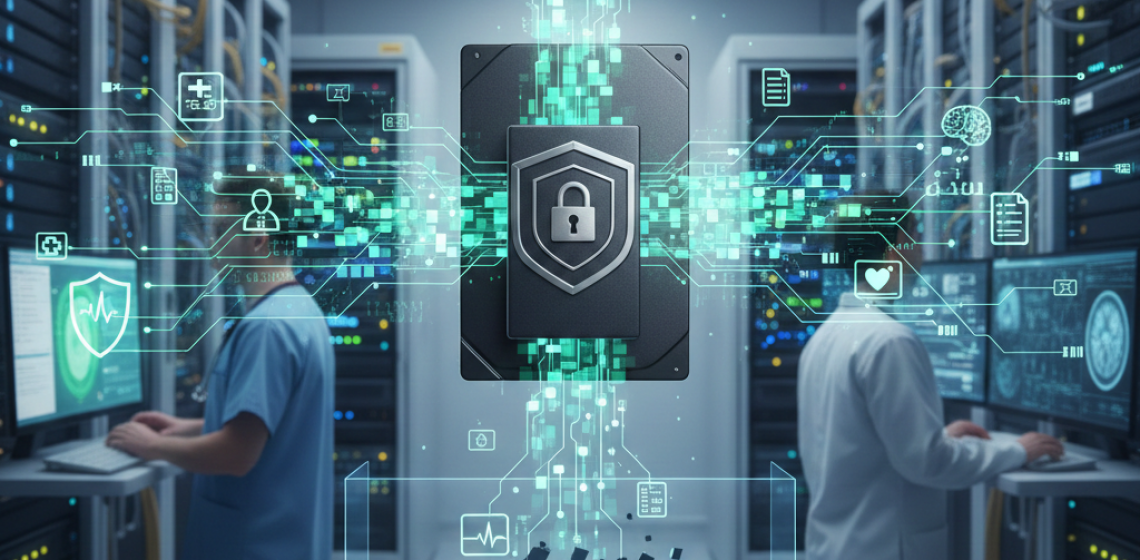
Hospitals save lives every day but behind every diagnosis and treatment lies equally sensitive patient data.
From medical histories to lab reports and insurance records, healthcare organizations manage thousands of files daily. Losing that data or allowing it to leak can cause more than financial damage. It can cost trust and even lives.
In an age where digital health records rule, the only real safeguard is strong data encryption built directly into the hardware. That’s why healthcare providers are turning to Self-Encrypting Drives (SEDs) to secure storage solutions that make sensitive patient data unreadable to anyone without authorization.
And that’s where Fidelity Height steps in empowering hospitals and clinics to protect their data with advanced hard drive encryption and data loss prevention software.
Every healthcare organization is now a digital enterprise.
From MRI machines to billing systems, everything connects through networks and storage devices.
But according to global reports, one out of every three healthcare organizations experiences a data breach each year.
The reasons are clear:
To stop this, the solution must begin where the data lives the drive itself.
That’s where self-encrypting disks and SED drives provide the highest level of protection.
A Self-Encrypting Drive (SED) is a storage device that automatically encrypts all data written to it and decrypts it only for authorized users.
Unlike external tools or programs, SED drives use built-in encryption chips to secure files directly inside the SSD or HDD.
This is known as hardware-based encryption, and it’s far more reliable than software-based encryption methods because it doesn’t depend on your operating system or computer performance.
Even if someone removes the drive from the system, they can’t read or copy the data without the encryption key.
Healthcare organizations can’t afford delays or data loss.
From critical lab results to real-time monitoring systems, performance and uptime are essential.
That’s why hardware encryption through Opal drives is ideal for the healthcare industry.
Key benefits include:
By using Opal Lock by Fidelity Height, healthcare IT teams can activate encryption across all devices instantly, ensuring patient data stays protected at every level.
Many hospitals rely on software encryption tools that protect data at the application or OS level.
While helpful, they come with major drawbacks:
In contrast, hardware-based encrypted software like Opal Lock doesn’t rely on system resources. It encrypts data directly in the drive, maintaining smooth performance for medical operations that run 24/7.
Electronic Health Records are at the core of every healthcare organization.
These contain sensitive details like prescriptions, family history, billing, and diagnosis data.
Without data encryption software, these records can be stolen, altered, or leaked.
Using self-encrypting disks ensures all patient data is encrypted the moment it’s written.
Even if a drive is stolen or replaced, the encrypted information remains useless without the key.
This automatic protection is critical for maintaining data privacy and general data protection in the healthcare sector.
Security isn’t just about keeping data safe; it’s about controlling how it moves.
Data loss prevention services and data loss prevention software track, monitor, and block unauthorized sharing of sensitive files.
When integrated with hardware encryption, healthcare providers gain a double layer of defense:
With Fidelity Height solutions, administrators can enforce policies that ensure only authorized users can access or transfer patient data, reducing human error and accidental exposure.
Hospitals store massive amounts of patient information in databases such as lab results, appointments, billing, and insurance records.
Database protection tools ensure this information stays confidential and tamper-proof.
Database activity monitoring goes one step further by identifying unusual access patterns, such as unauthorized logins or bulk data exports.
Paired with database security management, healthcare providers can maintain full visibility of how data is used, accessed, and modified.
When combined with self-encrypting drives, the entire data ecosystem from hard drive to database, stays locked from breaches.
Regulations like HIPAA and GDPR require healthcare organizations to secure patient information.
Failure to do so can result in fines, lawsuits, and loss of public trust.
Hardware-based encryption through SED drives automatically meets compliance by ensuring all data is encrypted at rest.
It aligns with international standards for data protection and general data protection, making audits and certifications much easier to handle.
Opal drives, compliant with the Trusted Computing Group (TCG) Opal standard, are designed for organizations that deal with sensitive data daily.
They automatically encrypt every file stored, without any need for user interaction.
Opal Lock by Fidelity Height enhances this technology by adding management, monitoring, and policy enforcement tools.
This gives hospitals and clinics total control over their SSD drives and HDD drives, ensuring no device leaves the facility with readable data.
Not all threats come from hackers.
Sometimes data breaches occur internally from careless employees or unauthorized staff.
Data loss protection software and file encryption software make it impossible for unauthorized users to copy or share patient files.
Even if data is copied to another system or external drive, it remains encrypted and unreadable.
This ensures both accountability and data privacy within healthcare teams.
Doctors, nurses, and staff often carry laptops and tablets containing patient information.
When these devices are lost or stolen, unencrypted drives can become a serious liability.
Self-encrypting disks protect these devices automatically.
Even if a thief removes the drive, the encrypted files remain locked and unusable.
This gives hospitals peace of mind, knowing that their data protection continues beyond their walls.
Healthcare operations cannot afford delays.
When systems go down, it can affect patient treatment and diagnostics.
Hardware encryption ensures data protection without affecting performance.
Unlike traditional file encryption software, SEDs process encryption internally without slowing read or write speeds.
This reliability makes self-encrypting drives the ideal choice for healthcare IT systems that run 24 hours a day.
Traditional software encryption requires configuration for each computer.
In large hospitals, this process becomes time-consuming and prone to errors.
Hardware-based encryption automates the process.
Each drive encrypts itself automatically from the first moment it’s used.
With Opal Lock, IT teams can roll out data encryption across hundreds of laptops and medical systems in minutes, reducing administrative effort while increasing security.
During upgrades or repairs, hospital IT teams often need to access internal systems.
Without encryption, technicians could unintentionally expose sensitive data.
Self-encrypting drives prevent that.
Even during maintenance, all files remain encrypted and inaccessible without authorization.
This ensures complete data protection throughout the system’s lifecycle.
When hospitals replace old computers, those drives still contain years of patient data.
Simple deletion or formatting isn’t enough.
Data can still be recovered using forensic tools.
The solution is secure erase through hardware encryption.
By deleting the encryption key, all stored data becomes permanently unreadable.
Fidelity Height offers built-in secure erase management within Opal Lock, ensuring compliance with privacy regulations during IT asset disposal.
As healthcare becomes more digital, data volumes continue to grow.
Manual security tools won’t be enough.
Self-Encrypting Drives (SEDs) and Opal Lock are shaping the future of healthcare IT.
They offer automatic, invisible protection that requires no user action, ensuring every patient record, report, and image is always encrypted.
With rising threats and tighter regulations, hardware encryption is no longer optional — it’s essential.
Q1. Why are self-encrypting drives important for healthcare?
– They automatically protect patient records using hardware-based encryption, ensuring no data can be accessed without authorization.
Q2. What makes hardware encryption better than software encryption in hospitals?
– Hardware encryption works inside the drive, providing faster performance and stronger protection for sensitive healthcare data.
Q3. How do SED drives help with data loss prevention?
– They integrate with data loss prevention services to block unauthorized data sharing and maintain full control of patient information.
Q4. Can encrypted drives prevent insider threats?
– Yes. Data loss protection software ensures that only authorized staff can access and transfer files, keeping data private within the organization.
Q5. How does Fidelity Height support healthcare data protection?
– Through Opal Lock, hospitals can enable self-encrypting disks, manage encryption policies, and achieve full compliance with general data protection standards.
Patient care starts with trust and trust begins with data security.
Empower your healthcare organization with Opal Lock by Fidelity Height, ensuring your systems, drives, and records are protected with hardware-level encryption and data loss prevention software.
Because in healthcare, protecting lives means protecting data first.
